Inflection Points
·
September 2026
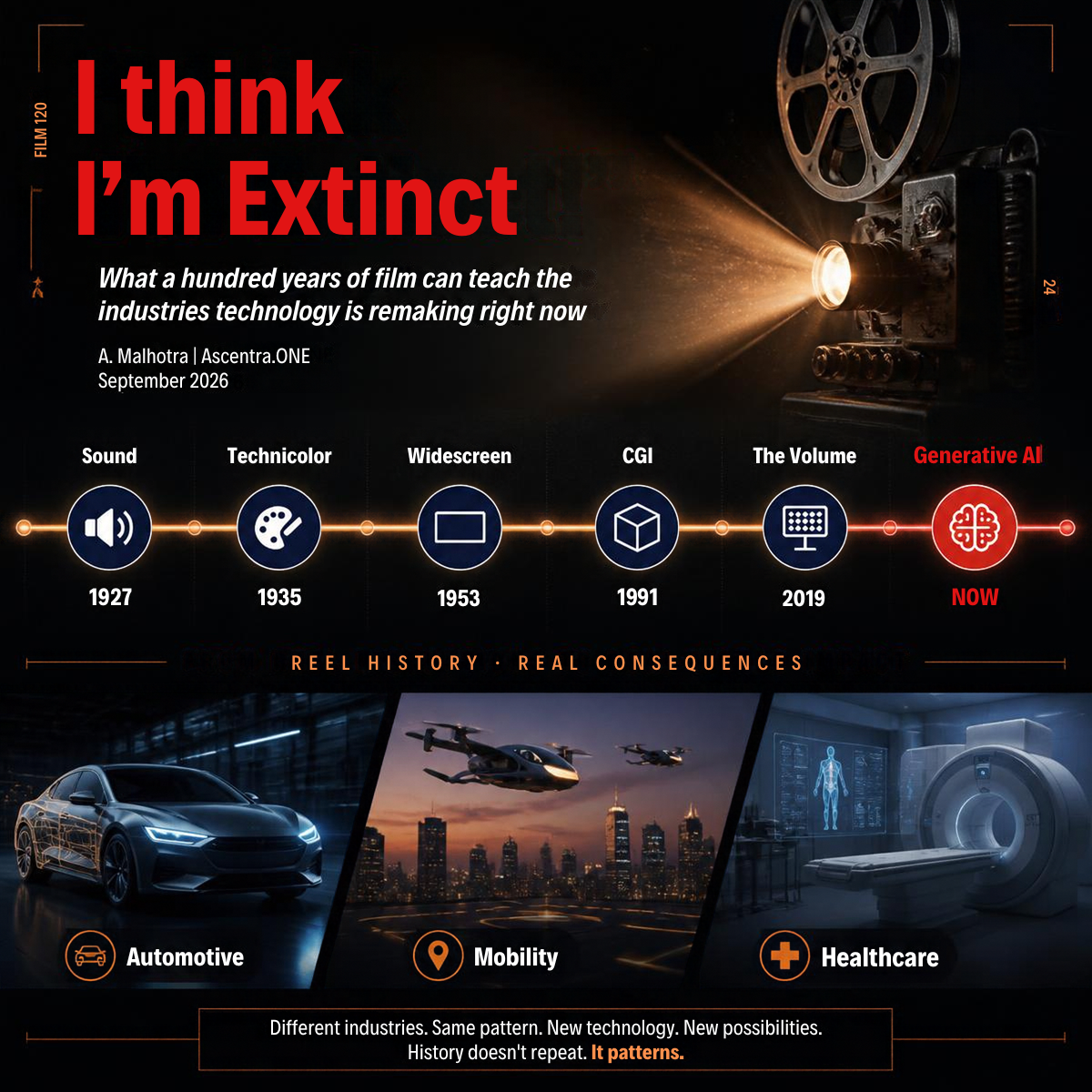
5
0
Disruption comes in two kinds: layer-level shifts that collapse a service built on a stable industry, and industry-level shifts that move the floor itself.
The error that ends companies is not missing the disruption — it is misdiagnosing which level it is operating at.
Generative AI is the first technology in film’s lineage aimed at authorship and performance rather than production logistics — and healthcare and automotive face the same question.
Every industry has inflection points. Most executives have learned to expect them. What they’re less prepared for is the difference between the two kinds.
The first kind operates at the layer level. A technology or a new business model collapses a specific service, revenue stream, or competitive advantage built on top of an otherwise stable industry. The industry itself survives and sometimes barely notices. The casualties are the companies that built their identity around riding that particular layer. When GPS navigation arrived on the smartphone, the market for dedicated in-vehicle navigation devices collapsed almost overnight. The connected vehicle market restructured around it. The vehicles kept rolling off the line. When broadband connectivity made high-volume, daily-use services viable in the vehicle with rich navigation, streaming, over-the-air updates, and infotainment ecosystems, customers experienced what connected could mean every time they drove. Safety & Security telematics, built on a low-bandwidth, low-frequency-use premise, didn’t become technically obsolete. It became contextually insufficient. The pressure wasn’t displacement, rather, it was expectation inflation. The layer that got disrupted wasn’t the service category itself; it was the premise that it alone was enough to define a connected vehicle business.
The second kind operates at the industry level. This is not a layer collapsing. This is the floor moving. The underlying premise of how value is created in terms of what the product fundamentally is, who builds it, and who captures the economics, gets replaced rather than upgraded. These disruptions are rarer. They propagate more slowly, which makes them easier to misread as something manageable. And they are existential for incumbents who mistake them for a layer problem and respond accordingly. Toyota's just-in-time manufacturing, which spread globally in the 1970s and 80s, didn’t just improve automotive assembly economics, it restructured global supply chains, reset quality expectations, and took American OEMs the better part of two decades to fully absorb. Ford’s moving assembly line sixty years earlier had done the same thing in the opposite direction: it didn’t improve craft coachbuilding; it made craft coachbuilding economically irrelevant.
Layer-level disruptions happen constantly. The industry-level ones are the ones that define eras. The strategic error that ends companies is not failing to see disruption coming. It is misdiagnosing which level it is operating at. To understand the two concepts better, it can be easier to look at industries other than what is familiar and examine how inflection points changed underlying assumptions and created new value, with new players that went on to dominate the next era.
Film is an unusual case study because it has been through both kinds, repeatedly, in documented sequence over a single century. Six industry-level inflection points, each one replacing a premise the previous era was built on, alongside at least as many layer-level disruptions running in parallel: home video that hastened the decline of drive-ins but ultimately enriched the studios; DVD that created and then destroyed a bonus-content economy; streaming that started as a distribution disruption and is now, mid-metastasis, beginning to touch what gets made and how. Understanding how the industry navigated each, what it got right, and where the pattern is now breaking is not an exercise in film history. It is a framework for reading what is currently happening in automotive, mobility, and healthcare — and for understanding why the current moment in all three feels different from anything that came before.
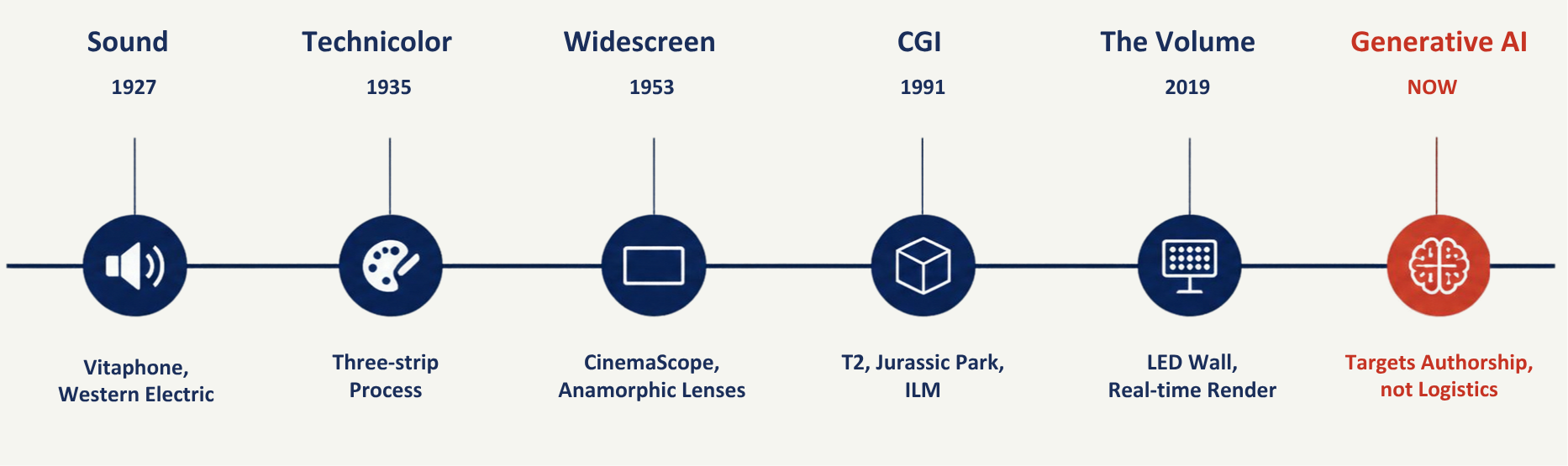
Figure 1. Six technology shifts that reset filmmaking rules, 1927 to present. The AI point marks a break from the pattern.
For the first thirty years of cinema, film was a silent medium. Orchestras played live in the theater. Actors learned to convey everything through expression and movement. Title cards carried the dialogue. The entire grammar of filmmaking had been built around the absence of recorded sound, and it worked well enough that nobody was in a hurry to change it. Then it changed almost overnight. The Jazz Singer used Western Electric's Vitaphone system, and within a few years American and German engineers converged on the lasting approach: sound recorded directly onto the film itself. The result wasn't just movies with audio. It created entirely new departments such as Sound Mixing, Foley, and Automated Dialog Replacement (ADR) that didn't exist before and that the industry still depends on a century later.
Early cinema was black and white not by choice but by limitation. Hand-tinted frames and two-strip processes existed, but color on screen was expensive, inconsistent, and technically fragile: a curiosity rather than a standard. Three-strip Technicolor, developed by Herbert Kalmus's Boston-based company, changed that by making color commercially viable rather than a novelty. The Wizard of Oz used the format's then-startling jump from sepia to color as a plot device, and launched an era where technology became part of the storytelling, not just the delivery.
By the early 1950s, audiences had a reason to stay home: television. Theater attendance dropped sharply, and Hollywood needed a reason to get people back into seats; something a small black-and-white box in the living room couldn't replicate. The answer was scale. CinemaScope borrowed an anamorphic lens design, the Hypergonar, that a French inventor named Henri Chrétien had patented decades earlier and that had mostly sat unused. Fox licensed it, rebranded it, and reshaped how films were composed for the next half-century. The wider frame became not just a visual choice, but a competitive response to a platform threat.
Before computers entered the conversation, the challenge of showing the impossible on screen fell entirely to craftspeople working with physical materials such as foam, latex, animatronics, hydraulics, and forced perspective. Rick Baker, Stan Winston, and Rob Bottin pushed that craft about as far as the medium could go, producing work in films like The Thing, An American Werewolf in London, and Aliens that still holds up technically. This is worth pausing on, because it's the high-water mark right before the next shift made the entire craft category economically uncompetitive for certain kinds of shots. The ceiling they hit was not just artistic; it was also physical as some things simply could not be built to deliver the same audience impact.
The question the industry had been asking was whether a computer could generate imagery convincing enough that an audience would believe it. The T-1000 in Terminator 2 proved computer graphics could carry a character convincingly. Two years later, Jurassic Park proved it could replace a living creature on screen entirely. Ironically, the film is remembered for computer graphics, but most of its dinosaur close-ups were still Stan Winston's hydraulic puppets. The wide shots and the stampede were the few minutes of CGI that ended up changing the industry.
Phil Tippett, the stop-motion specialist hired for the production, watched the early CGI tests and reportedly told Spielberg, “I think I’m extinct.” Spielberg liked the line enough to work a version of it into the film.
The standard solution to filming in a place you can't physically go such as an alien planet, a medieval battlefield, or the surface of a star, had always been green screen: shoot the actors against a blank backdrop and composite the environment in post-production. It worked, but it was expensive, time-consuming, and required actors to perform against nothing. The Mandalorian popularized a different approach: massive, curved LED walls displaying real-time rendered environments, wrapping the set in a photorealistic world that moved and lit correctly as the camera moved through it. It collapses location shooting, visual effects, and practical production into a single stage. The workflow implications are still being worked out, but it's the clearest current example of the same pattern: a new technology absorbing a production constraint that used to require physical travel and a separate VFX pass.
It’s tempting to tell this story as Hollywood inventing its way forward, but the record doesn’t support that as a general rule. The first three decades of cinema were disproportionately European: the Lumière brothers in France held the first public projected screenings in 1895, beating Edison’s peep-show Kinetoscope to what actually became “cinema.” Georges Méliès, also French, pioneered in-camera visual effects like multiple exposures and stop tricks, largely on his own. Soviet filmmakers Sergei Eisenstein and Lev Kuleshov developed montage theory, the idea that editing itself produces meaning, which is still taught in every film program. German Expressionist lighting, refined in the 1910s and 20s, became American film noir once its practitioners emigrated to Hollywood in the 1930s.
After sound, though, the pattern shifts. Technicolor, the core CGI pipeline (Pixar’s RenderMan, ILM’s compositing tools), and most of the digital infrastructure of modern filmmaking were built in the United States, not imported and commercialized. Dolby is a notable exception which was founded in England before the technology was adopted by Hollywood in the late 1970s. The honest version of the story is a split timeline: European origination in the silent and early sound era, American infrastructure-building from sound onward, with real exceptions running both directions.
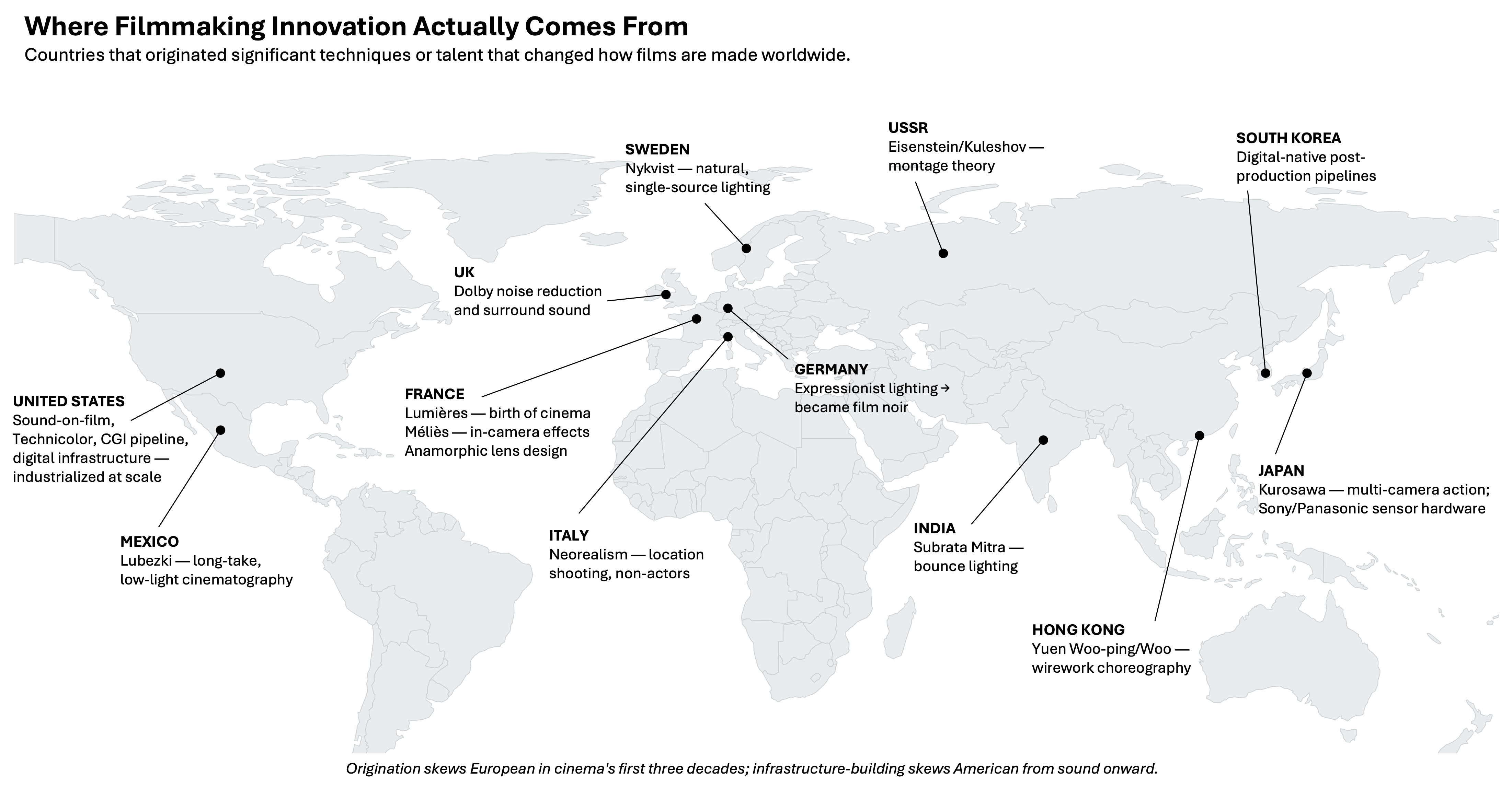
Figure 2. Countries that have originated significant filmmaking innovations — techniques and people that changed how films are made, not just where they’re distributed.
Widen the lens past the US, UK, USSR, Germany, and France, and the list of meaningful contributions gets longer:
A notable gap in the list is China — hold that thought. There is a pattern within the pattern: most are methodology and talent exports, involving a technique or a person that spread, rather than discrete inventions like Technicolor or an anamorphic lens. The distinction matters when the claim is "who innovated," because they are different kinds of contribution. What unites them, however, is that each shift — invention or methodology; American, European or Asian in origin — targeted how films were made, not who was needed to make them. That distinction held for a century. Will it continue to hold?
Extrapolate the chart above and you can build a reasonable-sounding argument that this ends with zero human talent. But look closely at what each prior shift really displaced, and a pattern emerges that cuts the other way: sound removed the need for live musicians and title cards. CGI removed the need for physical sets and creatures in some shots. Performance capture removed the need for prosthetics, but not the actor. The Volume removes the need for location travel, but we still need a cinematographer.
Every one of these technologies targeted production logistics. None of them, until now, have targeted the performance or authorship itself.
Generative AI is the first technology in this lineage aimed at the layer that was previously untouchable: who delivers the line, who wrote it, who decided how the scene should feel.
That makes it a different kind of disruption: one that is in kind, not just in degree. Which is exactly why simple extrapolation would be the wrong tool to use here. A few reasons the “eventually zero humans” version is a bad bet:
Then there is The Odyssey — and the summer of 2026 ran something close to a controlled experiment.
Christopher Nolan shot the film entirely on IMAX 70mm, the first feature ever made that way. The Cyclops was an animatronic with a live performer inside the scene; Circe's transformations were built from puppetry, makeup, and stage magic. Three days before it opened, an AI studio unveiled its own version of the same story: Odysseus: The Fall, 135 minutes, generated entirely with AI tools for a mid-five-figure budget. Nolan's film has since grossed more than $1.6 billion, the highest of any R-rated film in history. The AI version found no theatrical distributor upon release — it is available to rent online.
It isn't a fair fight. The budgets differ by a factor of several thousand. But it is a clear signal: in the same season a fully synthetic alternative was one click away, audiences paid a premium, at historic scale, for the most physically human filmmaking available.
That is reassuring. It is not conclusive. A preference is not a floor, and what audiences reward in a theater is not necessarily what they accept on a phone.
What the future looks like may already be taking shape though, but not in a Hollywood studio lot. Instead, it is developing on Chinese streaming platforms.
Fang Taozi is a fully AI-generated character who stars in a short-form drama called The Girl Who Was Laid Off — a small-town woman pursuing a modeling career in the city. She has visible pores. Her makeup deteriorates across a long day. She looks tired when the scene calls for it. None of it is real. In August 2026, her drama had crossed 250 million views, she had accumulated nearly half a million followers, and her promotional rates reportedly exceed those of some human influencers with 10 million followers. One viewer wrote: “She is so authentic. Now I believe that AI can genuinely replace human actors.”
That last sentence is doing more work than it appears to. Audiences don’t connect with Fang Taozi despite knowing she is synthetic, but because she feels real. The imperfections are engineered and the relatability designed, and it has worked at a scale that has human performers in China paying attention.
The conditions that enabled this are specific to China: platform economics that reward volume, fast-moving rules around synthetic performers, and a cultural comfort with virtual characters that predates generative AI. These don't map directly onto Western theatrical exhibition — yet. China, though, has a way of running experiments at a scale that makes "yet" a dangerous word. It built the world's largest e-commerce infrastructure before most Western retailers had figured out mobile checkout. It turned short video into a mass medium, with hundreds of millions of daily users on Douyin, before Western platforms had figured out how to make the format pay. In creative industry disruption, the next floor shift has historically come from wherever the constraints are lowest and the audience is largest.
Both of those conditions describe China.
Film is the case study. The pattern is the point.
Every industry runs both kinds of disruption simultaneously. Layer-level events happen more frequently, more visibly, generating more immediate urgency. Industry-level shifts propagate underneath them more slowly, more quietly, until they aren't quiet anymore. The strategic error that ends companies is not failing to see disruption coming. It is misdiagnosing which level it is operating at — and deploying a layer-level response to something that is moving the floor.
Automotive and mobility are running this experiment right now, at both levels at once. The rideshare disruption was layer-level: it restructured urban mobility economics and challenged personal vehicle ownership assumptions in dense markets, but it did not change what a car is or how it is made. The OTA software update began the same way; a layer level disruption to the dealer service revenue model for certain repair categories, survivable if managed. But the software-defined vehicle is something different. It started as a layer story. Software as a service layer on top of the physical platform. It metastasized. When the software stack becomes the product, when the architecture defines the competitive position rather than the powertrain, when the OEM's most important partners are no longer tier-one suppliers but platform companies, the floor has moved. The companies treating SDV as a feature upgrade are making the same mistake the silent film studios made in 1927: assuming that the new thing will sit on top of the existing model rather than replace its premise.
Healthcare is further into the same transition than most people inside it realize. The employer-sponsored insurance model that defines U.S. healthcare economics was itself a layer built on top of medicine in the postwar period. It was a workaround for wage controls instituted during the war that accidentally became the infrastructure everyone designed around. Direct Primary Care is not a billing innovation. It is a recognition that the intermediary layer is not load-bearing. Medicine can be practiced, and practiced better, without it. The DPC physician who moves off insurance billing and onto direct patient relationships is running the same experiment the film industry ran when it realized that constraints it had built entire workflows around were never inherent to filmmaking at all. Meanwhile, AI diagnostics is doing to clinical judgment what generative AI is doing to authorship in film: approaching the layer that every prior disruption left untouched. Whether that resolves as a layer event or an industry event is the open question. The answer will determine the shape of healthcare for the next generation.
What makes the current moment genuinely unusual is not that these industries are being disrupted. It is that layer-level and industry-level disruptions are running simultaneously, at speed, and are increasingly difficult to tell apart from inside them. A layer-level response to an industry-level threat is not just insufficient — it consumes resources and attention that would have been needed for the harder work.
The question that matters most is not "are we disrupted?" Almost every organization knows the answer to that. The question is: is this moving our layer, or is it moving the floor?
If this article is doing its job, it should leave you with more questions than answers. Here are four derived from the film industry that are more broadly applicable and worth sitting with:
This article is part of the Inflection Point series — essays exploring how technology reshapes industries, careers, and the nature of work itself.
What the Builders Leave Behind
Two centuries of infrastructure booms, the busts that followed, and what they suggest about the AI build-out.
The Real Cost Gap
How Direct Primary Care changes the healthcare affordability equation. A white paper built from a working practice.

If this question is live in your organization — or your career — that’s the conversation.
Get in touch