Commercialization
·
August 2026

4
0
With employer coverage already in place, pairing DPC with a high-deductible plan saves roughly 2–11% of gross annual cost — the stronger case there is access and continuity.
Without employer coverage, the same math produces a gap that more than triples, to roughly 30–40%.
DPC changes which insurance a patient actually needs: it closes the primary-care gap that makes a Bronze plan risky on its own.
Direct Primary Care (DPC) is a fast-growing alternative model in American healthcare: patients pay a flat monthly membership fee for their primary care — including unlimited same- or next-day visits, longer time spent with their doctor, and no per-visit co-pays — and may separately carry insurance or a health-sharing plan for everything outside primary care: specialists, hospitalization, imaging, and emergencies. Pairing a DPC membership with the right insurance plan can cost meaningfully less than standard insurance alone — but the size of that gap depends entirely on which insurance option is being compared, and whether the patient already has employer coverage: roughly 2–11% of gross annual cost when employer coverage is already picking up part of the tab, versus 30–40% when it isn't. This analysis walks through that comparison in full: five realistic patient scenarios, two distinct coverage situations, and the line-item math behind every figure.
The numbers behind that comparison come from a real DPC practice rather than modeled estimates: Aurora Primary Care, a DPC practice in Rockville, Maryland founded by Dr. Mudita Malhotra, MD, FAAFP, serving patients across Maryland, DC, and Northern Virginia. Aurora's published membership pricing is used to build this analysis, paired with real, live-quoted 2026 Maryland marketplace rates. Visits include virtual appointments as well as in-person ones. Patients can also message their doctor directly between visits and that back-and-forth isn't limited or billed separately, but it is also not counted in the visit-based figures used below. Aurora publishes a shorter, patient-facing version of the figures below on its own website.1
Aurora's membership fee is fixed and public, and anchors the “Aurora” column in every table below:
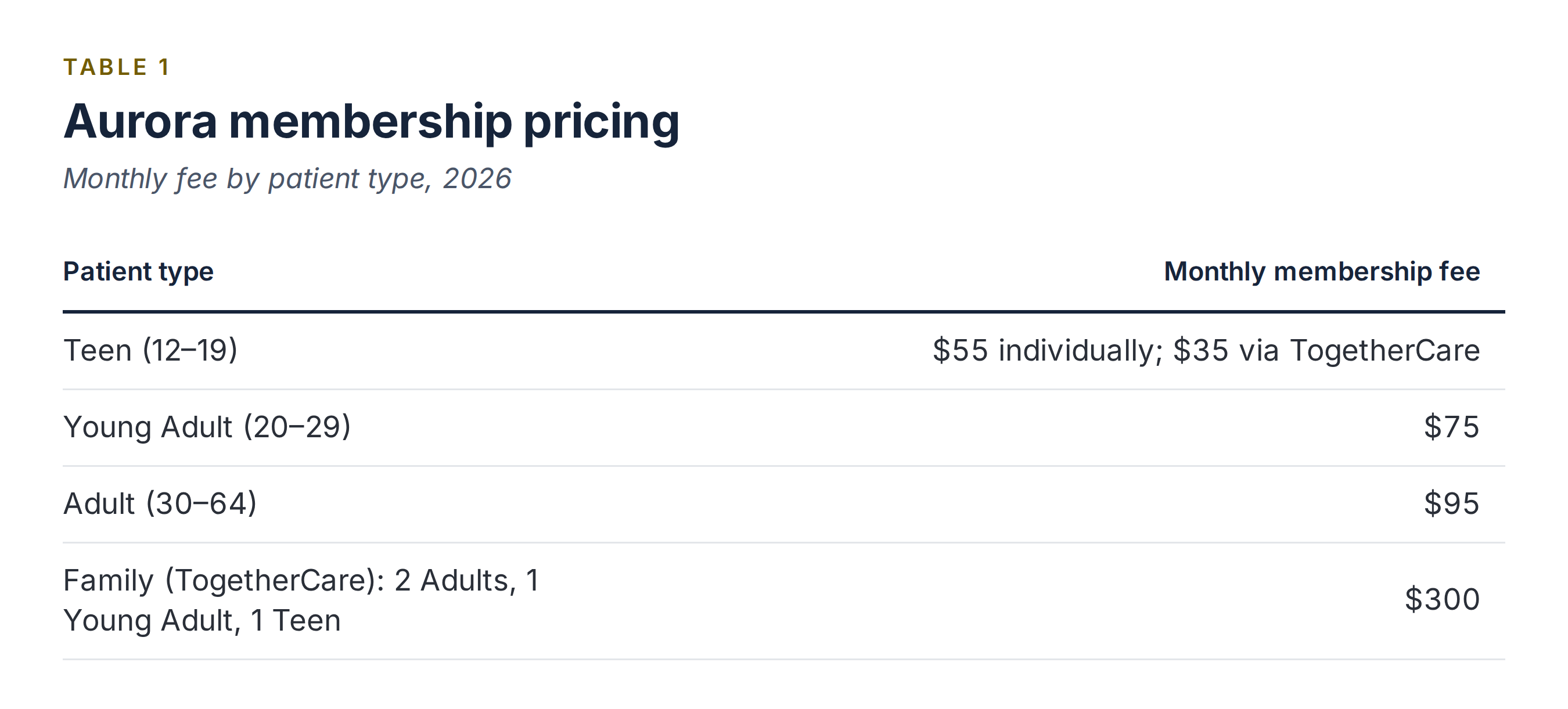
Every marketplace premium in this analysis comes directly from Maryland Health Connection2 — real 2026 plan-year quotes for a single adult, a family of four, a single parent of two, and an early retiree, all in Rockville, MD (zip 20850) — cross-checked against Maryland Insurance Administration's 2026 approved-rate exhibits3.
Lab costs use the FAIR Health average billed amount4 — the provider's list charge before any insurance negotiation is applied. An insured patient at an in-network lab owes the insurer's negotiated allowed amount even before meeting a deductible. We use the billed benchmark because it's the FAIR Health figure publicly available — see “Two Tracks” for how that shapes Track A's 2–11% range. Costs higher than this range are possible if an out-of-network lab runs the tests. Aurora's own lab pricing — negotiated directly with its lab partner — runs 60–85% below standard insurance billing rates across Aurora's lab menu1 and that gap drives the small “Annual labs” figures in the Aurora column of every table below. Visit and lab-utilization counts for each profile were based on typical primary care guidance for that kind of patient, rather than assumed.
All figures are illustrative examples built from a defined set of assumptions, not personalized insurance quotes. They assume no ACA premium subsidy; lower-income households may qualify for a subsidy that reduces real costs below what's shown. Individual costs vary by age, income, household size, and the specific plan chosen.
This analysis covers two distinct situations, and the size of the gap depends heavily on which one applies.
Track A compares Aurora plus a high-deductible plan against an employer-sponsored plan, for patients who already have employer coverage — Sarah and the Kapur family, below. Track B compares the same combination against buying marketplace coverage entirely on one's own, with no employer contribution on either side — Alex, Daniela, and Marcus. Track B is where the larger numbers live, because there's no subsidy absorbing part of the premium for either option being compared.
Track A savings run roughly 2–11% of gross annual cost, depending on FAIR Health benchmark prices. Sarah’s and the Kapurs’ tables use the billed-rate benchmark pricing them at 11%: $360 and $1,249/year. Priced at insurers’ actual negotiated (allowed) rates instead, we estimate the same two comparisons would land near 2% (actual dollar amounts not publicly available). Track B savings run 30–40% of gross annual cost — $1,810 to $5,777/year across the three profiles below — more than triple Track A’s, since no employer subsidy offsets either side of that comparison.
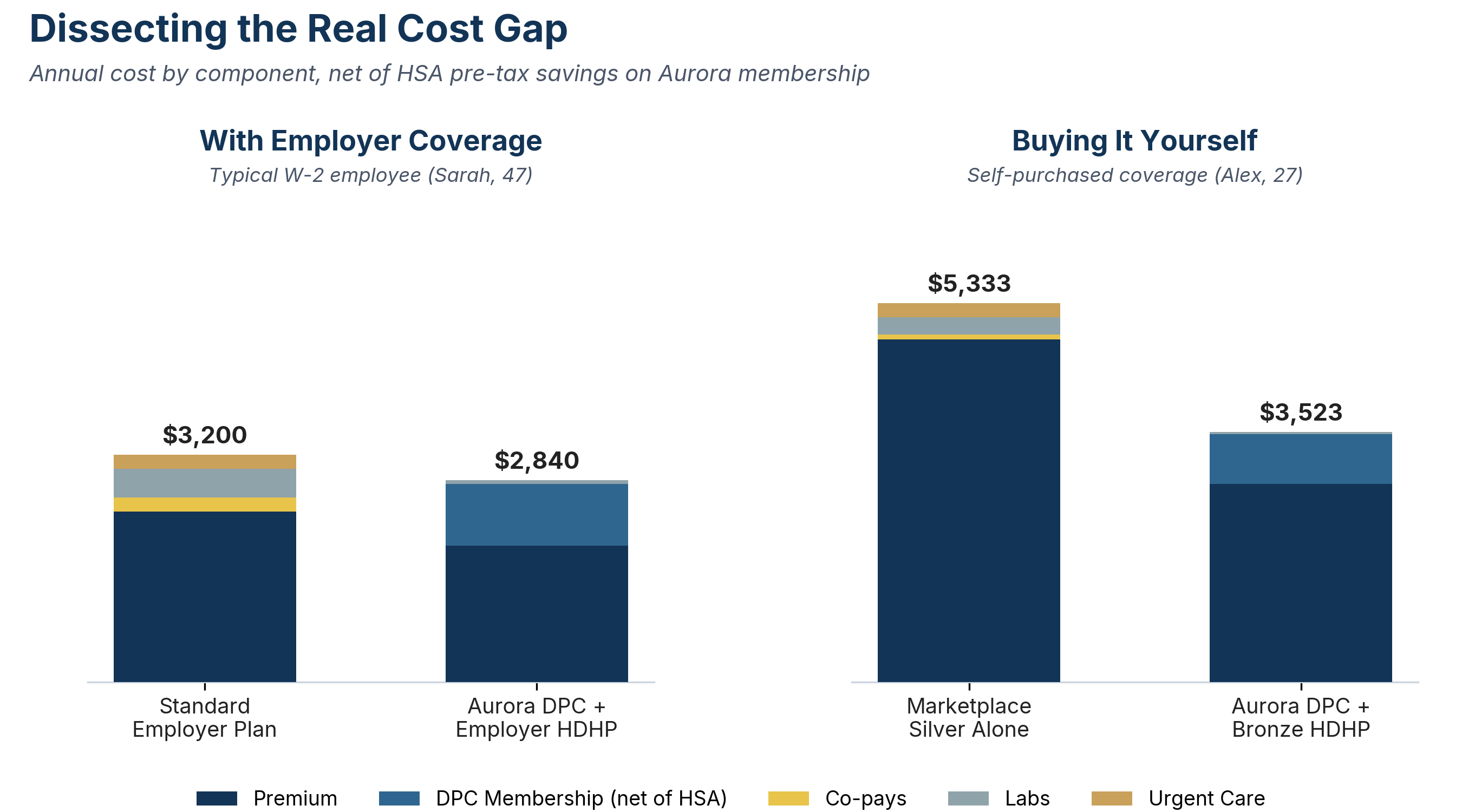
The five profiles below span that whole range, from a modest employer-plan savings to the largest gap for someone paying for insurance entirely on their own. Exhibit 2 previews the pattern before the line-item detail for each one.
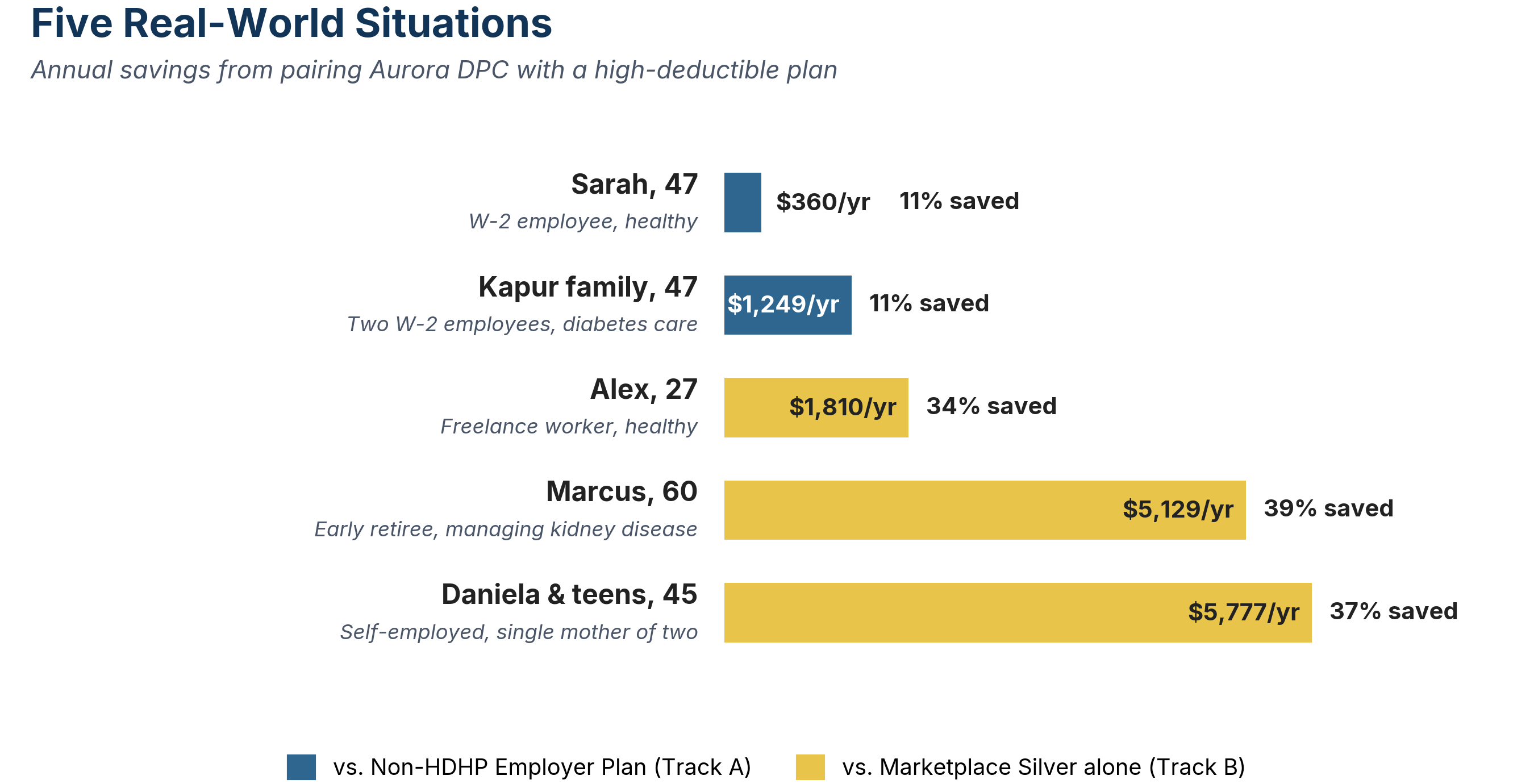
The dollar figures below use average billed lab and visit rates, consistent with the methodology above — an upper bound on the gap. Using real in-network negotiated rates instead, Track A's savings compress meaningfully, toward the low end of the 2–11% range described above or below. In practice, for patients who already have solid employer coverage, DPC's primary value isn't a large dollar savings — it's same-day access, an unhurried visit, and a doctor who already knows their history. Read the figures below with that in mind.
Sarah, 47 — Employed Adult
Sarah is insured through her employer. Her cholesterol and blood pressure run a little high, so her doctor orders bloodwork at her annual visit and a follow-up draw mid-year — active monitoring of a known issue, billed as diagnostic care rather than free preventive screening.
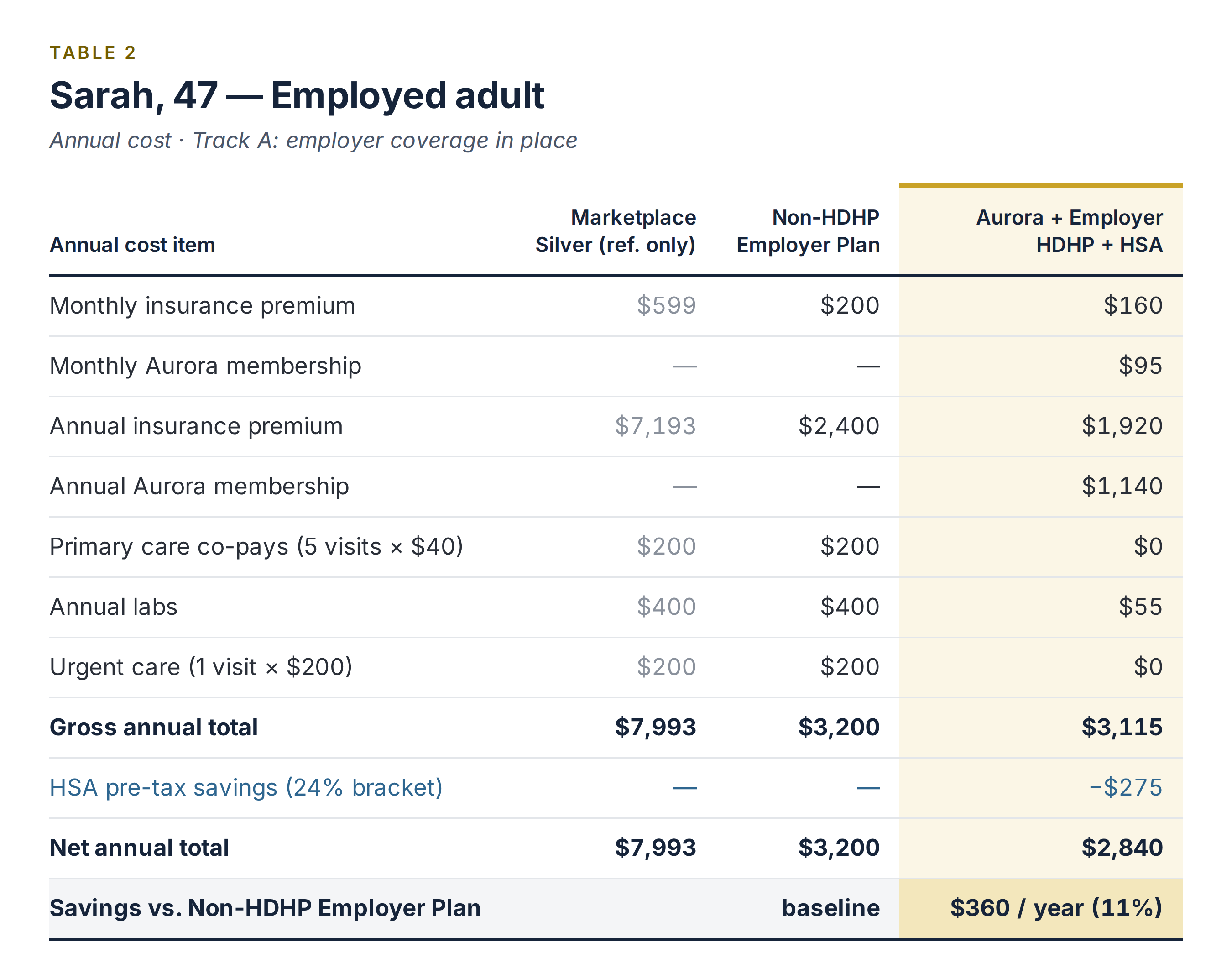
The Marketplace Silver column shows how much of Sarah's premium her employer is effectively covering. That reference only holds while she stays in this job — if she left or lost this coverage, Marketplace Silver is roughly what she'd be shopping for on her own, which is what makes the size of that column worth paying attention to, not just theoretical.
The Kapur Family — Two Parents (47 & 47), Ages 23 and 18
Mr. Kapur's diabetes is checked with quarterly monitoring labs; Mrs. Kapur's cholesterol and blood pressure are followed with a mid-year draw. Both are diagnostic care rather than routine screening. The 23- and 18-year-old get standard annual panels along with everyone else's routine care.
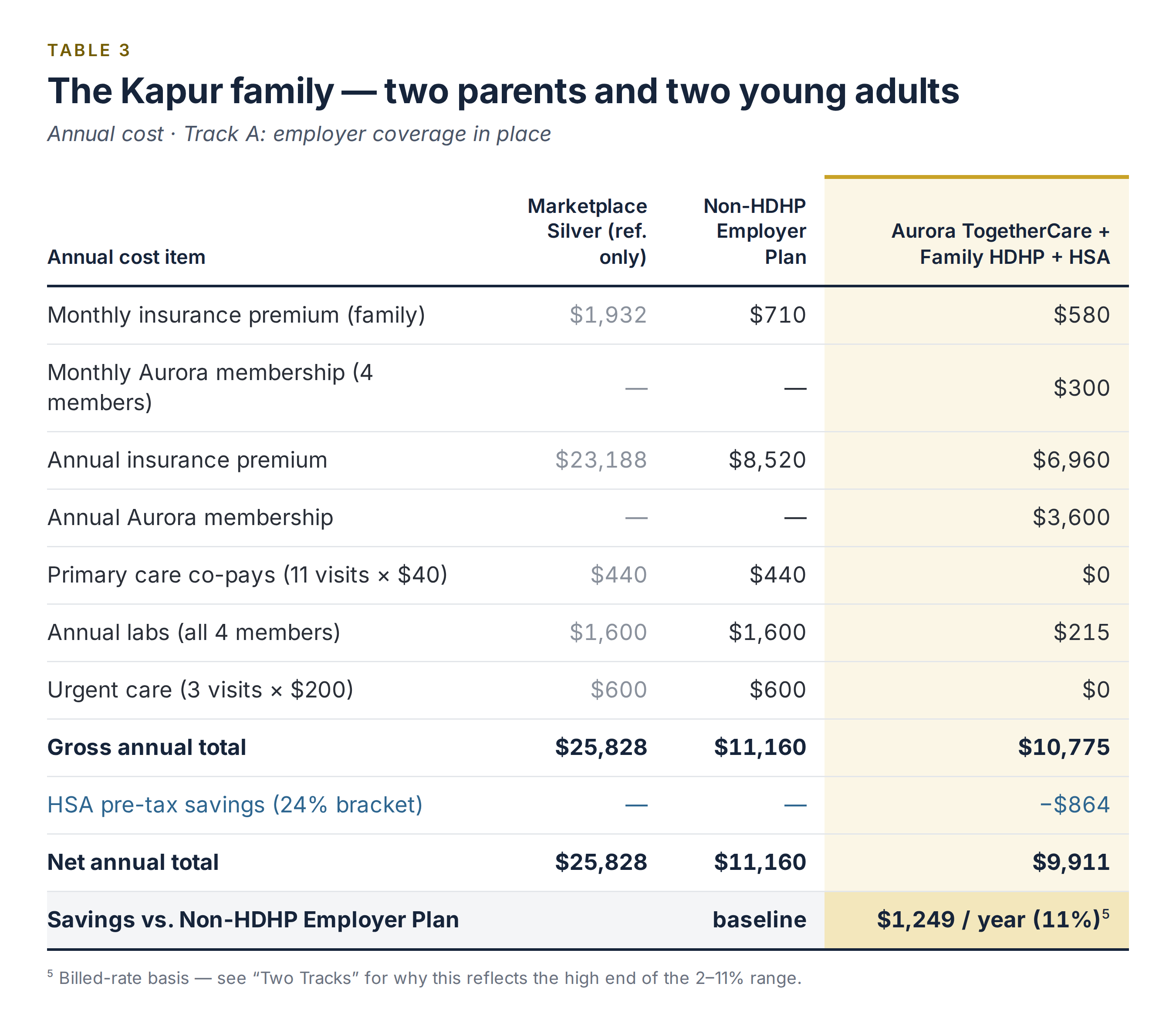
As with Sarah, the Marketplace Silver column here reflects what the family would likely be shopping for if this employer coverage were no longer available — not a plan they'd buy today.
Visit count reflects 4 visits for Mr. Kapur, 3 for Mrs. Kapur, and 2 each for the 23- and 18-year-old, based on typical utilization for a household managing this kind of routine chronic-condition monitoring.
Alex, 27 — Freelance, Self-Purchased Insurance
Alex is healthy with no ongoing conditions, so the bloodwork at his annual check-up is routine, not monitoring for a diagnosed issue.
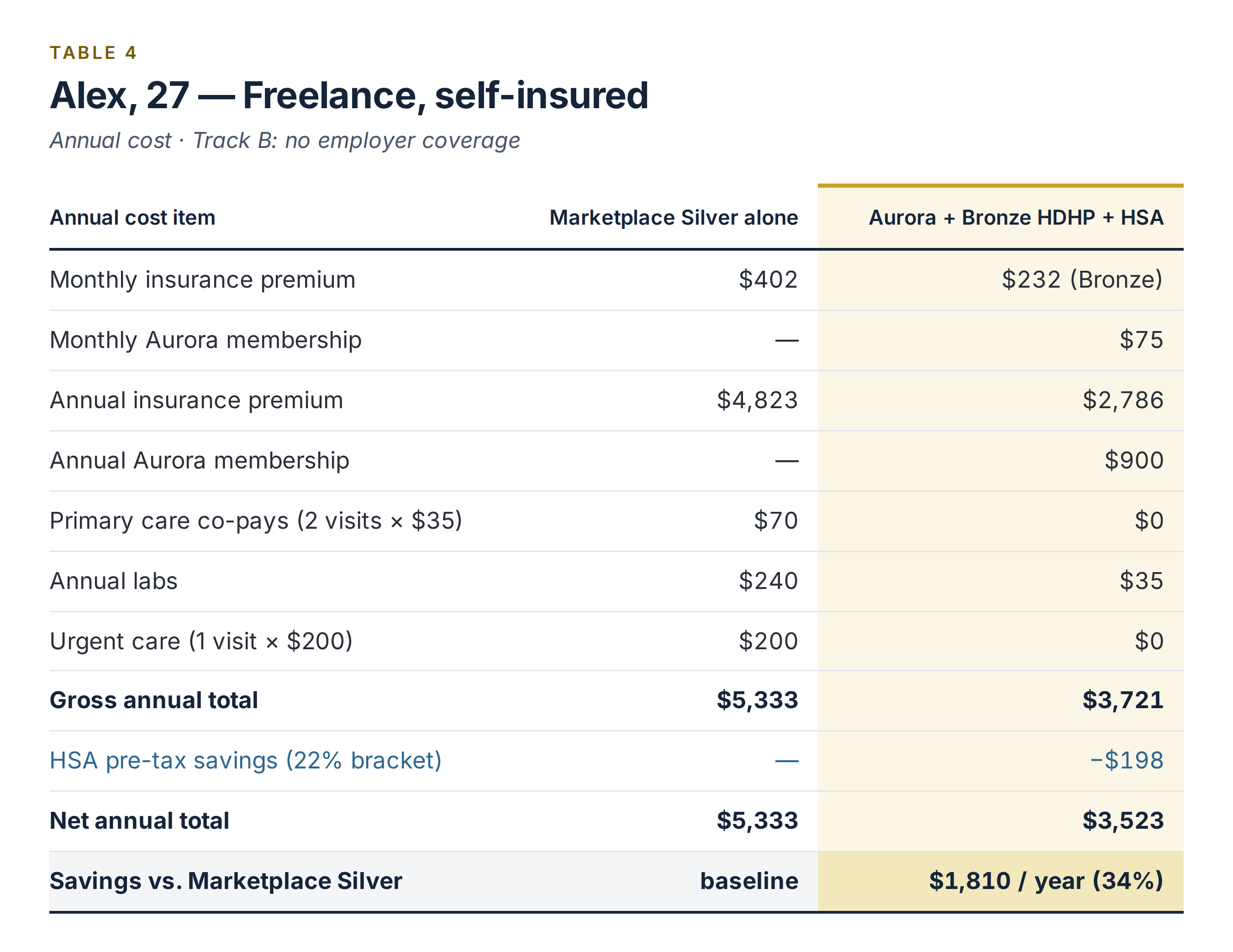
Real 2026 Maryland Health Connection quote, age 27, Rockville (20850). Assumes no ACA premium subsidy — household income under roughly $62,600/year (400% of the federal poverty level for a household of one, under 2026 rules) may qualify for one.
Daniela, 45 — Independent Contractor Real Estate Agent, Single Mother of Two
Daniela is a 1099 real estate agent raising two teenagers on her own. One of them manages anxiety and checks in with their primary care doctor more often than a typical teen; none of the three has a condition requiring monitoring labs, so their labs are standard annual panels.
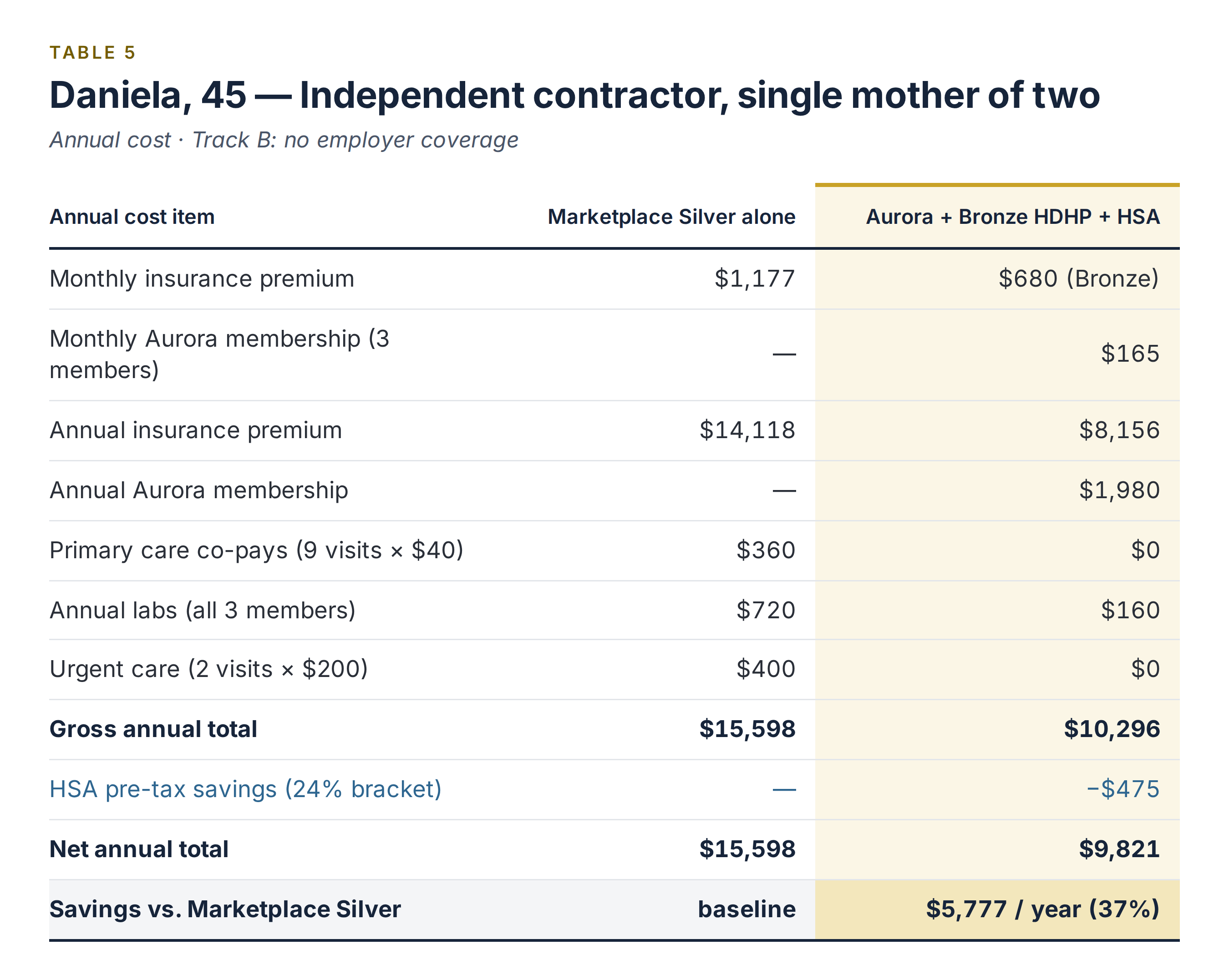
Visit count: 3 for Daniela, 4 for the teen managing anxiety, 2 for the other teen. Assumes no ACA premium subsidy — household income under roughly $106,600/year (400% of the federal poverty level for a household of three, under 2026 rules) may qualify for one. The largest savings gap in this analysis.
Marcus, 60 — Early Retiree, Pre-Medicare, Managing Stable Kidney Disease
Marcus retired early and manages a stable, well-controlled kidney condition tracked with an extra blood test twice a year, on top of his annual check-up panel — active monitoring of a diagnosed condition, not a free preventive screening.
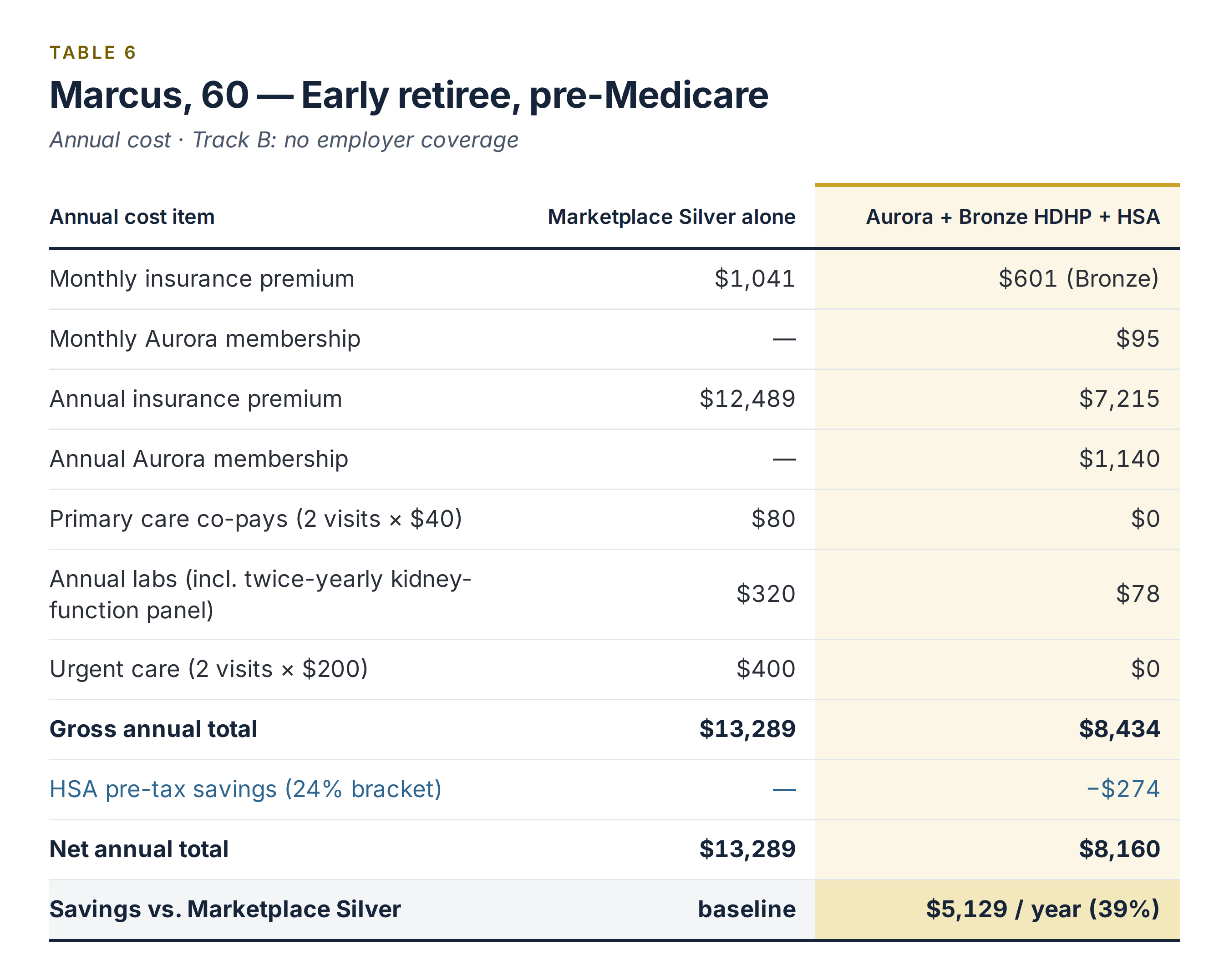
Real 2026 quote, age 60, Rockville. Assumes no ACA premium subsidy. Maryland Marketplace premiums rise roughly 11% every three years under the ACA age-rating curve6, so this gap widens with age — one reason it's especially relevant during the years between employer coverage and Medicare eligibility.
Across all three Track B profiles — a healthy 27-year-old freelancer, a single mother of two managing a teen's anxiety, and a retiree managing stable kidney disease — the gap holds in a narrow band: 34% to 39% of gross annual cost. Different life stages, different health needs, similar gap.
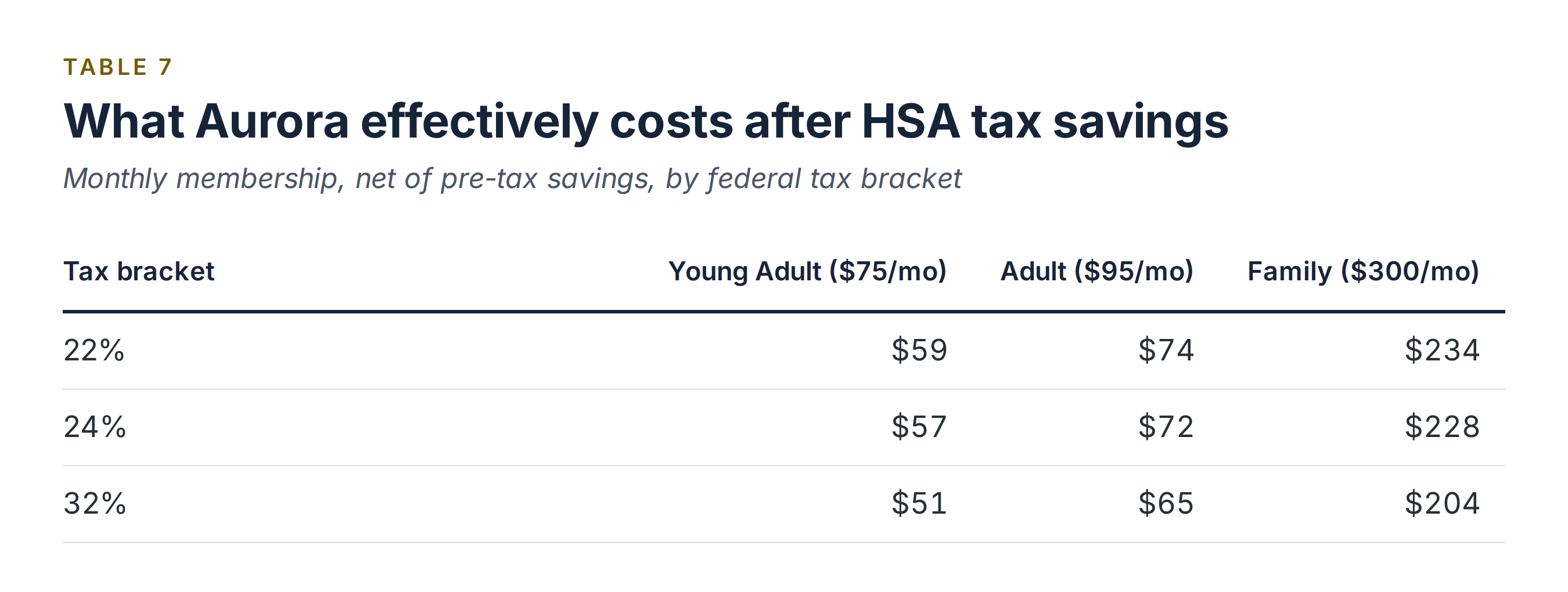
Under IRS Notice 2026-057, implementing provisions of the One Big Beautiful Bill Act, DPC membership fees became HSA-eligible starting January 1, 2026 — up to $150/month for individual coverage and $300/month for family coverage. That's the source of the HSA line in every table above. Applied to Aurora's own membership pricing, the effective monthly cost after HSA tax savings looks like this:
Every comparison in this document uses Marketplace Silver — not Bronze — as the "buying insurance without Aurora" baseline. Silver is the ACA benchmark tier: it's the plan the marketplace uses to calculate subsidy eligibility, and its cost-sharing — modest, fixed co-pays for office visits and urgent care — is close to what most people picture when they think of "having insurance" and going to the doctor. That makes it the fairer stand-in for the alternative most patients are actually weighing.
It's a fair question whether a Bronze plan bought on its own, without a DPC membership, would beat both options. Bronze premiums are real: they run roughly 40% below Silver for the same person — Alex pays $232/month for Bronze versus $402/month for Silver. But that discount comes with a trade-off Silver doesn't have. A Bronze plan is a true high-deductible design, meaning there's little to no coverage for office visits, labs, or urgent care before the deductible is met — the patient pays close to the full negotiated rate for that care out of pocket rather than a fixed co-pay. Silver's co-pays exist precisely because Silver plans build in more first-dollar coverage; Bronze plans are priced lower because they don't.
That's the trade Aurora's model is built around. Pairing Aurora with a Bronze plan captures the lower Bronze premium while replacing the exposed, pay-full-price gap for primary care with a flat monthly membership and unlimited visits. Buying Bronze alone keeps the lower premium but leaves that gap open — a patient with any regular need for primary care, labs, or urgent visits could offset some or all of the premium savings paying cash for that care until the deductible is met.
This document doesn't model a "Bronze alone, no DPC" column directly — full retail pricing for uninsured-rate office visits varies too much by provider to state a single figure with confidence. But the direction is clear enough: Bronze alone isn't the free upgrade it looks like from the premium line alone, and it's a different, riskier basket than what's compared here.
The deductible on a high-deductible plan is real, and worth stating plainly rather than minimizing. In a typical year, Aurora covers essentially all primary care needs, so the deductible is rarely triggered by everyday care. But if a major event occurs — a hospitalization or surgery — total out-of-pocket costs in that specific year could exceed what a standard plan would have cost. The savings shown above are a durable, multi-year advantage, not a guarantee that applies to every individual year regardless of what happens.
Track A’s savings — roughly 2–11% of gross annual cost, a few hundred to just over a thousand dollars a year — describe patients whose employer is already absorbing a large share of the premium, and whose case for DPC rests mainly on access and continuity rather than dollars. That’s only part of the picture. For the segment with no employer plan behind them — retirees, the self-employed, small-business employees — the same math produces a gap that more than triples, to roughly 30–40% of gross annual cost, simply because both sides of the comparison are being paid for out of pocket rather than one side being subsidized.
This analysis is built entirely from Maryland data — Montgomery County premiums, Maryland Health Connection quotes, Maryland's approved-rate exhibits — so it's worth asking how it would look elsewhere. Two data points from KFF's national surveys give a rough sense of the range.
On the employer side (Track A), KFF's 2025 Employer Health Benefits Survey put the national average annual premium at $9,325 for single coverage (worker's share: $1,440) and $26,993 for family coverage (worker's share: $6,850)8. Employer premiums in the DC/Maryland metro area typically run 20–25% above the national average9, so Track A's dollar gap would likely look smaller in a lower-cost state and similar or larger in another high-cost metro.
On the marketplace side (Track B), the relationship runs the other way: Maryland has some of the lowest Bronze marketplace premiums of any state10, so the gap shown for Alex, Daniela, and Marcus is closer to a floor than a ceiling — someone running the same comparison in a higher-premium state would likely see a larger gap, not a smaller one.
These are directional observations from published national averages, not a recomputation of this analysis for another state. Someone outside the Maryland/DC/Virginia market should treat the pattern — Track A modest, Track B substantial — as the takeaway, not the specific dollar figures.
DPC changes the calculation in three ways, not one.
First, it replaces piecemeal billing with a single flat fee: premiums, co-pays, and urgent care are covered outright, and labs come at a steep, built-in discount — all settled before insurance ever enters the picture. That's why the dollar savings shown throughout this analysis exist at all, regardless of which insurance option sits alongside it.
Second, it changes what insurance a patient actually needs to buy. As “Why Marketplace Silver, Not Bronze” describes, a Bronze plan’s real weakness isn’t the premium — it’s the exposed, pay-full-price gap in primary care before the deductible is met. DPC closes exactly that gap, which is what makes a lower-premium Bronze plan a genuine option instead of a risk, without giving up continuity of primary care.
Third — and this matters most for patients who already have solid employer coverage, where Track A’s dollar savings are modest — the experience itself is different by design: same- or next-day access, visits that run roughly four times longer than a typical primary-care appointment1, and one doctor who knows a patient’s history year after year, rather than the fragmented, rushed default fee-for-service billing produces.
None of that requires the largest number in this analysis to be the true one. The mechanism, the marketplace-economics shift, and the experience hold whether a given household lands at 2% or 40% — which is also why this document shows the range, rather than the figure that tells the best story.
Ascentra.ONE is a strategic advisory practice founded by Anupam Malhotra, advising organizations navigating inflection points in their industries. In healthcare, that currently means Aurora Primary Care, a Direct Primary Care practice in Rockville, MD founded by Dr. Mudita Malhotra, MD, FAAFP — whose real-world membership pricing and patient-visit patterns anchor every figure in this analysis. The methodology, framing, and conclusions throughout are Ascentra.ONE’s own.
Full citations for each data source appear as footnotes throughout this document. Prepared by Ascentra.ONE, September 2026.
Illustrative examples built from defined assumptions, not personalized insurance or financial quotes — actual costs depend on your plan, employer contribution, age, location, and healthcare usage. Ascentra.ONE and Aurora Primary Care are not licensed insurance brokers or financial advisors; review your own plan documents and consult a licensed professional before making coverage decisions.
I Think I’m Extinct
What a hundred years of film can teach the industries technology is remaking right now.
What the Builders Leave Behind
Two centuries of infrastructure booms, the busts that followed, and what they suggest about the AI build-out.

If this question is live in your organization — or your career — that’s the conversation.
Get in touch